
On Crapitalism...
And the Origins of Our Discontent

I think about it more than I’d like to admit—my own discontent, our families’ discontent, the discontent that hums beneath our news cycles, social feeds, and national psyche. We seem unsettled, without direction, unmoored. Some of this may just be the lens of a human in the messy middle of life. But I don’t think it’s just me. I suspect I’m sitting right on the mean, feeling what millions of my fellow citizens are feeling: restlessness, frustration, and a gnawing sense that something essential has slipped away.
What do I mean by discontent? A wanting that feels unanswerable. My family, my friends, my co-workers—pretty much everyone I know is searching. We chase experiences, possessions, diversions. Yet beneath all that motion is a deeper yearning for direction and ascent. An existential search for what we at M|B|P have come to call the Right to Rise. Human beings have always searched for this right, but today the ache feels especially acute, so much so that it bleeds into our daily lives, fueling anxiety and unease.
We are not short on diagnosis. Every hour brings another essay, podcast, or think-piece outlining what might be wrong with us. What’s missing are clear answers—explanations that distinguish symptoms from sources of things standing in the way of our Right to Rise, and practical paths to counter them.
In my own reflection, three sources of discontent preventing our path back to the Right to Rise stand out: Collapsing Community, Comparison Culture, and Crapitalism.
Collapsing Community
I learned about the collapsing community early. At nine years old, my family moved to a town whose fate rose and fell with a slate mine and later a Goodyear mill. When the work expanded, so did the town; when it contracted, so did the civic soul. Agriculture and small businesses dotted the landscape, but even they depended on larger economic tides and required fewer hands with each passing year.
Over three decades working in places like Chattanooga, Detroit, and Akron, I’ve seen that collapsing communities are not just sad—they’re lethal. They erode human health more insidiously than hurricanes or earthquakes. Katrina devastated New Orleans, but Detroit was hollowed out by a slow-motion population collapse that lasted half a century.
The mechanics are simple: when populations shrink, infrastructure doesn’t. The roads still need paving, the water still needs pumping, the neighborhoods still need policing. The burden on those who remain only grows heavier. And what decays first is not just infrastructure, but the connective tissue of social life. Robert Putnam chronicled this long ago in Bowling Alone. Where a community collapses, social capital withers.
And when community collapses, loneliness blooms. In the absence of steady human connection, we feel an existential hollowness. Digital “networks” do not bring casseroles when a family is grieving or invite you to a pickup game when you need laughter. We need handshakes, shared meals, off-the-cuff happy hours. Without them, we scroll ourselves into despair, trying to fill a tribal hunger with the junk food of screens.
Comparison Culture
That brings me to the second source of discontent: comparison culture powered by digital dopamine. Our devices deliver an unending stream of other people’s possessions, vacations, and curated joys. Even when we know it’s a performance, the parade shapes our imaginations.
We sit—entranced, addicted—like seniors at slot machines, slowly spinning away our attention, our time, our willpower. The comparison may be hollow, but our brains are wired to play along. I sometimes think social media will one day be classified like a Schedule 1 narcotic: high potential for abuse, no accepted medical benefit.
The cost is staggering. Instead of producing art, patents, cures, and big ideas, we consume infinite reels of digital detritus. A civilization that once innovated now numbs itself, measuring life by likes and followers. The tragedy is not just wasted time—it is wasted possibility.
Crapitalism
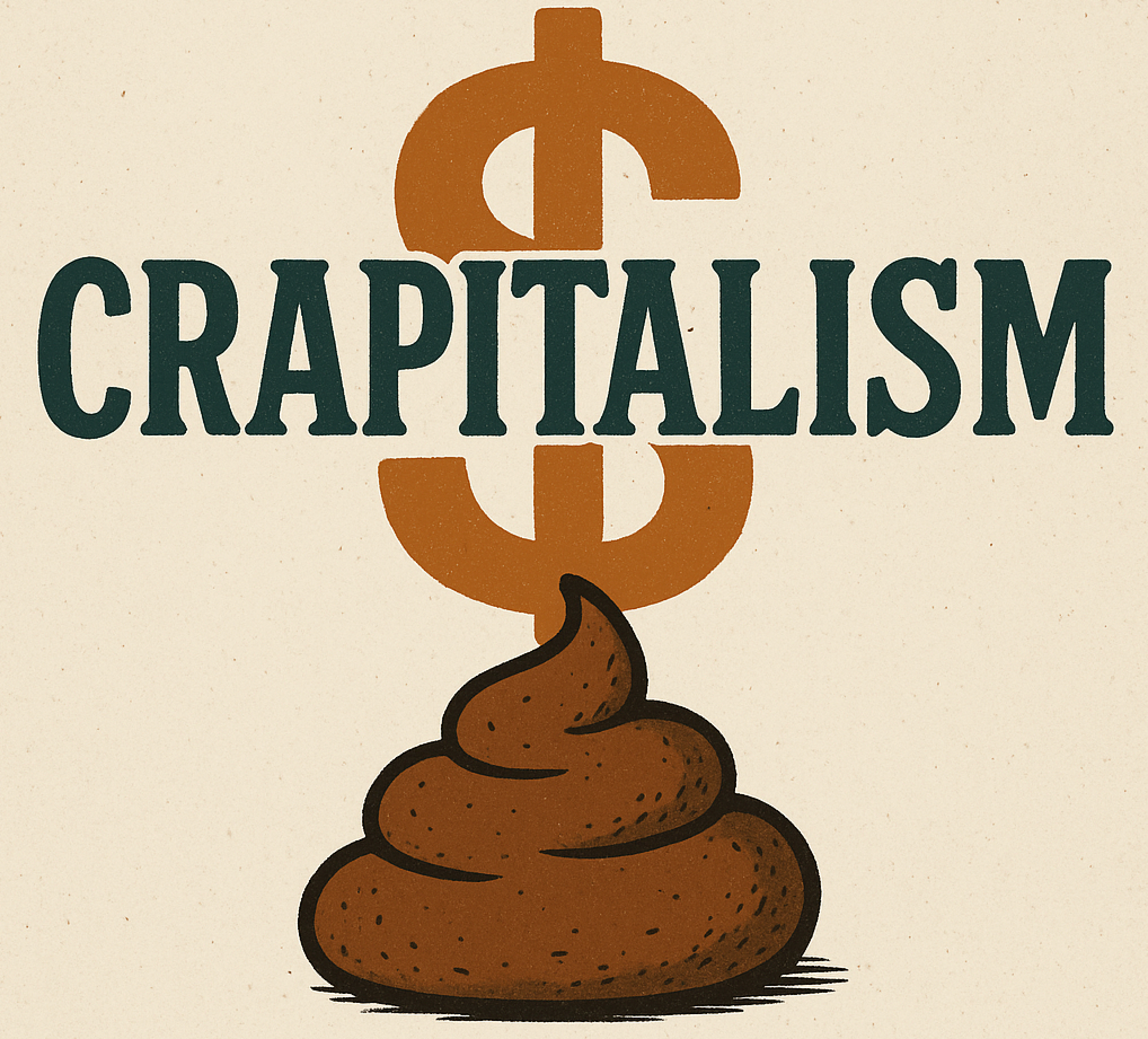
And then there is Crapitalism. A recent poll shows that barely half of Americans still believe capitalism is the best system. Among the young, skepticism is even higher. They’re not wrong. Wages stagnate, housing is unaffordable, inflation eats at savings, and job tenure is measured in months. The grand bargain of capitalism—that hard work yields stability and ascent—feels broken.
I’ve lived this paradox myself, reluctantly embracing the corporate world in midlife. From the inside of Fortune 500s and private firms alike, I’ve come to believe that what we practice today is not really capitalism. It is something darker: a hybrid of cronyism and financial extraction. Call it Crapitalism.
At its core are capital models that claim an obligation to maximize for strict financial gain alone — value stripped for the short term, communities destabilized, workers discarded. Megan Greenwell’s book Bad Company lays this out in devastating case studies. Crapitalism hollows out the very toeholds by which ordinary Americans might climb: the job that builds skills, the company that rewards loyalty, the city that anchors identity. What remains is a roller coaster of short-termism, excellence thwarted, mobility denied.
What Can One Person Do?
Faced with forces this large, what can one family possibly do? The temptation is despair. But I refuse to surrender. The answer is yes—we can act, even if only in miniature.
On Collapsing Community: Our family is moving to the Deep South with the intent to live car-light, join civic groups, and start a small neighborhood-rooted business. We say yes to potlucks, to walks, to fire-pit gatherings, to any chance at real face-to-face connection. The little rituals of presence are how we rebuild community.
On Comparison Culture: Three months ago, after a health scare, I quit social media cold turkey. The withdrawal was brutal—dopamine crashes, depression, the itch to scroll. But now? The days are slower, more deliberate. I write more. I listen better. I see my family. We will one day need societal infrastructure to support social media sobriety. For now, I’m building my own.
On Crapitalism: We are putting our money where our hearts are—choosing landlords who live in their buildings, spending at businesses run by their owners, seeking out non-profits over private equity-owned hospitals. Distance distorts capital, so we are shortening the distance. Every dollar is a vote for the kind of economy we want.
Ever Onward
None of this is about virtue signaling or Instagrammable moral gestures. It’s about creating, as Buckminster Fuller once urged, a new reality that renders the old one obsolete.
If you’re also wrestling with your own Right to Rise and the related discontent thereof, I’d love to learn from your experiments. Drop me a note. Let’s stitch together new forms of community, sanity, and dignity—one neighborly act, one honest purchase, one digital fast at a time.
Ever onward,
Josh
Please send observations, questions and thoughts to info@righttorise.us.
 | A guest post by
|